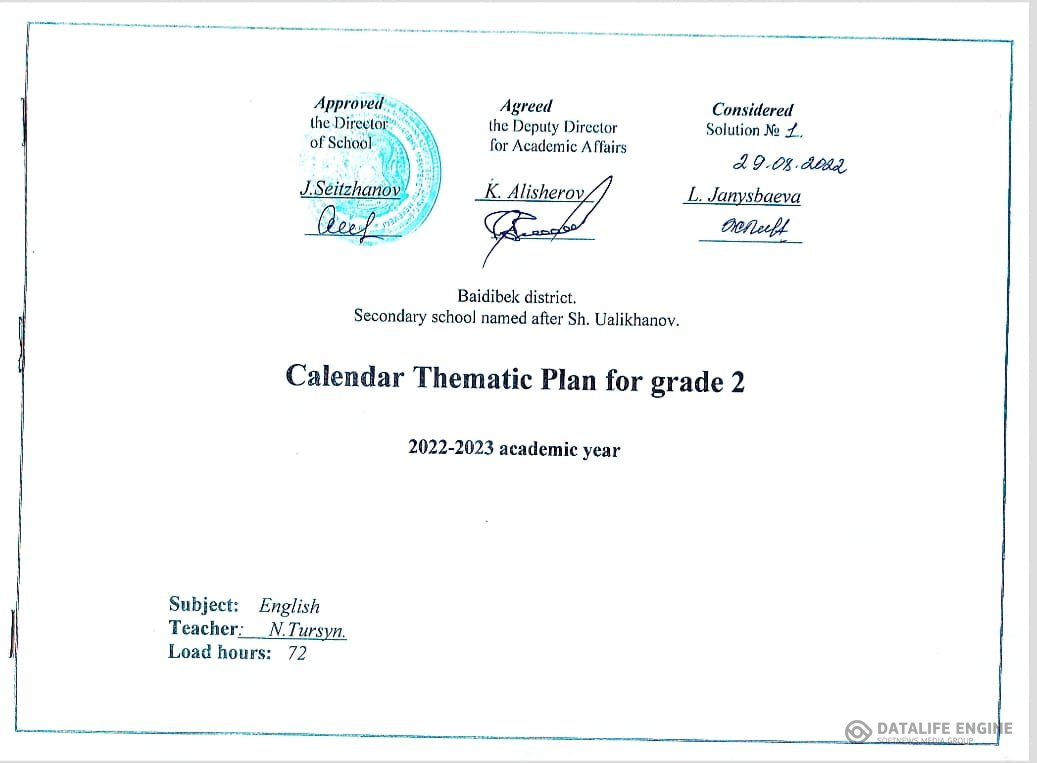
КТЖ 2 сынып Ағылшын тілі
№ | Unit/ Cross-cultural themes | Learning objectives | Hours | Date | Notes |
I term | |||||
Unit 1. All about me (9 hours) | |||||
1 | Greetings and family words. | 2.1.2.1 recognise with considerable support an increasing range of common personal questions 2.1.9.1 recognise the spoken form of familiar words and expressions 2.2.2.1 ask questions in order to satisfy basic needs and find information on familiar topics and classroom routines 2.2.6.1 use short answers appropriately in short, basic exchanges and take turns when speaking with others in a limited range of short, basic exchanges 2.3.4.1 begin to use with support a simple picture dictionary | 1 | 02.09.2022 | PB p.4 |
2 | Colours, numbers, days of the week. | 2.1.3.1 understand the main points of short, slow and carefully articulated talk on routine and familiar topics features such as colour and number 2.2.2.1 ask questions in order to satisfy basic needs and find information on familiar topics and classroom routines 2.2.6.1 use short answers appropriately in short, basic exchanges and take turns when speaking with others in a limited range of short, basic exchanges 2.3.4.1 begin to use with support a simple picture dictionary 2.4.5.1 write letters and familiar high frequency words when read aloud or spelt out for learners 2.5.2.1 use cardinal numbers 1 – 50 to count | 1 | 07.09.2022 | PB p.5 |
3 | Outdoor activities | 2.1.8.1 understand short narratives spoken slowly and distinctly on routine and familiar topics 2.1.9.1 recognise the spoken form of familiar words and expressions 2.3.6.1 understand with considerable and particularly visual support, some specific information in short, simple texts on familiar topics | 1 | 09.09.2022 | PB p.6 |
4 | Can/can’t | 2.1.8.1 understand short narratives spoken slowly and distinctly on routine and familiar topics 2.2.1.1 make basic statements related to personal information, people and objects on familiar topics and classroom routines 2.2.2.1 ask questions in order to satisfy basic needs and find information on familiar topics and classroom routines 2.2.6.1 use short answers appropriately in short, basic exchanges and take turns when speaking with others in a limited range of short, basic exchanges 2.4.3.1 write short phrases to identify people, places and objects 2.5.13.1 use can to talk about ability and to make requests and offers, use can/can’t to talk about permission | 1 | 14.09.2022 | PB p.7 |
5 | Clothes | 2.1.6.1 understand some specific information in short, slow, carefully articulated talk on routine and familiar topics 2.1.9.1 recognise the spoken form of familiar words and expressions 2.2.1.1 make basic statements related to personal information, people and objects on familiar topics and classroom routines 2.3.4.1 begin to use with support a simple picture dictionary 2.5.1.1 use singular nouns, plural nouns – including some common irregular plural forms in giving simple descriptions 2.5.14.1 use basic prepositions of location and position: at, behind, between, in, in front of, near, next to, on, to to describe where people and things are, use prepositions of time: on, in, at to talk about days and times | 1 | 16.09.2022 | PB p.8 |
6 | Diagnostic test | 2.1.6.1 understand some specific information in short, slow, carefully articulated talk on routine and familiar topics 2.3.3.1 Read and follow with considerable support simple words, phrases and sentences on familiar topics. 2.4.7.1 Spell some familiar high-frequency words accurately during guided writing activities. 2.2.3.1 Use a limited range of basic words, phrases and short sentences to describe objects, activities and classroom routines. | 1 | 21.09.2022 | Words |
7 | Phonics | 2.1.1.1 understand a range of short basic supported classroom instructions 2.2.5.1 begin to articulate clearly the difference between various sounds 2.3.1.1 read and spell out words for others 2.3.2.1 identify, remember and sound out high-frequency sound and letter patterns | 1 | 23.09.2022 | PB p.9 |
8 | Description of toys | 2.1.6.1 understand some specific information in short, slow, carefully articulated talk on routine and familiar topics 2.2.3.1 use a limited range of basic words, phrases and short sentences to describe objects, activities and classroom routines 2.3.5.1 understand the main points of simple sentences on familiar topics by using contextual clues | 1 | 28.09.2022 | PB p.10 |
9 | There is/there are. Unit assessment 1. | 2.1.9.1 recognise the spoken form of familiar words and expressions 2.2.2.1 ask questions in order to satisfy basic needs and find information on familiar topics and classroom routines 2.2.6.1 use short answers appropriately in short, basic exchanges and take turns when speaking with others in a limited range of short, basic exchanges 2.5.14.1 use basic prepositions of location and position: at, behind, between, in, in front of, near, next to, on, to to describe where people and things are, use prepositions of time: on, in, at to talk about days and times; 2.1.2.1 recognise with considerable support an increasing range of common personal questions; 2.1.3.1 understand the main points of short, slow and carefully articulated talk on routine and familiar topics features such as colour and number; 2.2.1.1 make basic statements related to personal information, people and objects on familiar topics and classroom routines. | 1 | 30.09.2022 | PB p.11 |
Unit 2. My family and friends (9 hours) | |||||
10 | Friends | 2.1.6.1 understand some specific information in short, slow, carefully articulated talk on routine and familiar topics 2.2.1.1 make basic statements related to personal information, people and objects on familiar topics and classroom routines 2.3.1.1 read and spell out words for others 2.3.6.1 understand with considerable and particularly visual support, some specific information in short, simple texts on familiar topics | 1 | 05.10.2022 | PB p.12 |
11 | Helping hands, Demonstrative pronouns | 2.1.6.1 understand some specific information in short, slow, carefully articulated talk on routine and familiar topics 2.2.2.1 ask questions in order to satisfy basic needs and find information on familiar topics and classroom routines 2.3.5.1 understand the main points of simple sentences on familiar topics by using contextual clues 2.4.7.1 spell some familiar high-frequency words accurately during guided writing activities 2.5.6.1 use demonstrative pronouns this, these, that, those to make and respond to requests for information 2.5.13.1 use can to talk about ability and to make requests and offers, use can/can’t to talk about permission | 1 | 07.10.2022 | PB p.13 |
12 | Feelings and emotions 1 | 2.1.8.1 understand short narratives spoken slowly and distinctly on routine and familiar topics 2.1.9.1 recognise the spoken form of familiar words and expressions 2.3.6.1 understand with considerable and particularly visual support, some specific information in short, simple texts on familiar topics | 1 | 11.10.2022 | PB p.14 |
13 | People’s feelings | 2.1.8.1 understand short narratives spoken slowly and distinctly on routine and familiar topics 2.2.1.1 make basic statements related to personal information, people and objects on familiar topics and classroom routines 2.2.2.1 ask questions in order to satisfy basic needs and find information on familiar topics and classroom routines 2.2.6.1 use short answers appropriately in short, basic exchanges and take turns when speaking with others in a limited range of short, basic exchanges 2.4.1.1 write with support short responses at phrase level to questions and other prompts 2.5.7.1 use personal subject and object pronouns to describe people and things | 1 | 14.10.2022 | PB p.15 |
14 | Feelings and emotions 2. | 2.1.6.1 understand some specific information in short, slow, carefully articulated talk on routine and familiar topics 2.1.9.1 recognise the spoken form of familiar words and expressions 2.2.1.1 make basic statements related to personal information, people and objects on familiar topics and classroom routines 2.3.4.1 begin to use with support a simple picture dictionary | 1 | 18.10.2022 | PB p.16 |
15 | Phonics. Sound ‘sh’. Unit assessment 2 | 2.1.6.1 understand some specific information in short, slow, carefully articulated talk on routine and familiar topics 2.1.9.1 recognise the spoken form of familiar words and expressions 2.2.5.1 begin to articulate clearly the difference between various sounds 2.3.2.1 identify, remember and sound out high-frequency sound and letter patterns 2.3.1.1 read and spell out words for others; 2.5.3.1 use common adjectives in descriptions and to talk about simple feelings; 2.4.7.1 spell some familiar high- frequency words accurately during guided writing activities; 2.5.7.1 use personal subject and object pronouns to describe people and things. | 1 | 21.10.2022 | PB p.17 |
16 | Feelings 3 | 2.1.6.1 understand some specific information in short, slow, carefully articulated talk on routine and familiar topics 2.2.4.1 respond to basic supported questions giving personal and factual information 2.3.6.1 understand with considerable and particularly visual support, some specific information in short, simple texts on familiar topics | 1 | 18.10.2022 | PB p.18 |
17 | Term assessment 1 | 2.L1 Understand a range of short basic supported classroom instructions 2.3.3.1 read and follow with considerable support simple, words, phrases and sentences on familiar and general topics and familiar instructions for classroom activities 2.W5 Write letters and familiar high frequency words when read aloud or spelt out for learners 2.UE1 Use singular nouns, plural nouns – including some common irregular plural forms in giving simple descriptions. 2.S2 Ask questions in order to satisfy basic needs and find information on familiar topics and classroom routines | 1 | 28.10.2022 | Revision PB p.4-17 |
18 | Feelings 4 | 2.1.1.1 understand a range of short basic supported classroom instructions 2.1.7.1 use contextual clues to predict content in short, supported talk on routine and familiar topics 2.1.8.1 understand short narratives spoken slowly and distinctly on routine and familiar topics 2.2.1.1 make basic statements related to personal information, people and objects on familiar topics and classroom routines 2.2.8.1 give simple instructions for others to follow | 1 | 21.10.2022 | PB p.19 |
II term | |||||
Unit 3. My school (6 hours) | |||||
19 | School subjects | 2.1.8.1 understand short narratives spoken slowly and distinctly on routine and familiar topics 2.1.9.1 recognise the spoken form of familiar words and expressions 2.3.6.1 understand with considerable and particularly visual support, some specific information in short, simple texts on familiar topics | 1 | 08.11.2022 | PB p.20 |
20 | We’ve got English. How many | 2.1.8.1 understand short narratives spoken slowly and distinctly on routine and familiar topics 2.2.2.1 ask questions in order to satisfy basic needs and find information on familiar topics and classroom routines 2.2.3.1 use a limited range of basic words, phrases and short sentences to describe objects, activities and classroom routines 2.5.2.1 use cardinal numbers 1 – 50 to count 2.5.14.1 use basic prepositions of location and position: at, behind, between, in, in front of, near, next to, on, to to describe where people and things are, use prepositions of time: on, in, at to talk about days and times | 1 | 11.11.2022 | PB p.21 |
21 | Places around school | 2.1.6.1 understand some specific information in short, slow, carefully articulated talk on routine and familiar topics 2.1.9.1 recognise the spoken form of familiar words and expressions 2.2.1.1 make basic statements related to personal information, people and objects on familiar topics and classroom routines 2.3.4.1 begin to use with support a simple picture dictionary 2.5.14.1 use basic prepositions of location and position: at, behind, between, in, in front of, near, next to, on, to to describe where people and things are, use prepositions of time: on, in, at to talk about days and times | 1 | 15.11.2022 | PB p.22 |
22 | Phonics. Sound ‘ch’ | 2.1.6.1 understand some specific information in short, slow, carefully articulated talk on routine and familiar topics 2.1.9.1 recognise the spoken form of familiar words and expressions 2.2.5.1 begin to articulate clearly the difference between various sounds 2.3.2.1 identify, remember and sound out high-frequency sound and letter patterns | 1 | 18.11.2022 | PB p.23 |
23 | Our school | 2.1.8.1 understand short narratives spoken slowly and distinctly on routine and familiar topics 2.2.1.1 make basic statements related to personal information, people and objects on familiar topics and classroom routines 2.3.5.1 understand the main points of simple sentences on familiar topics by using contextual clues | 1 | 22.11.2022 | PB p.24 |
24 | My class. Unit assessment 3 | 2.1.6.1 understand some specific information in short, slow, carefully articulated talk on routine and familiar topics 2.2.2.1 ask questions in order to satisfy basic needs and find information on familiar topics and classroom routines 2.2.6.1 use short answers appropriately in short, basic exchanges and take turns when speaking with others in a limited range of short, basic exchanges 2.2.3.1 use a limited range of basic words, phrases and short sentences to describe objects, activities and classroom routines. | 1 | 25.11.2022 | PB p.25 |
Unit 4. The world around us (8 hours) | |||||
25 | Different places | 2.1.6.1 understand some specific information in short, slow, carefully articulated talk on routine and familiar topics 2.2.1.1 make basic statements related to personal information, people and objects on familiar topics and classroom routines 2.3.6.1 understand with considerable and particularly visual support, some specific information in short, simple texts on familiar topics | 1 | 29.11.2022 | PB p.26 |
26 | Reading Signs. Where’s it from? | 2.1.9.1 recognise the spoken form of familiar words and expressions 2.2.2.1 ask questions in order to satisfy basic needs and find information on familiar topics and classroom routines 2.2.6.1 use short answers appropriately in short, basic exchanges and take turns when speaking with others in a limited range of short, basic exchanges | 1 | 02.12.2022 | PB p.27 |
27 | After-school activities | 2.1.8.1 understand short narratives spoken slowly and distinctly on routine and familiar topics 2.1.9.1 recognise the spoken form of familiar words and expressions 2.3.6.1 understand with considerable and particularly visual support, some specific information in short, simple texts on familiar topics | 1 | 06.12.2022 | PB p.28 |
28 | I do/I don’t do | 2.1.8.1 understand short narratives spoken slowly and distinctly on routine and familiar topics 2.2.3.1 use a limited range of basic words, phrases and short sentences to describe objects, activities and classroom routines 2.4.7.1 spell some familiar high-frequency words accurately during guided writing activities | 1 | 09.12.2022 | PB p.29 |
29 | Places to go. Unit assessment 4 | 2.1.6.1 understand some specific information in short, slow, carefully articulated talk on routine and familiar topics 2.1.9.1 recognise the spoken form of familiar words and expressions 2.2.1.1 make basic statements related to personal information, people and objects on familiar topics and classroom routines 2.3.4.1 begin to use with support a simple picture dictionary 2.5.4.1 use determiners a, an, the, some, any, this, these, that, those to identify things 2.3.6.1 understand with considerable and particularly visual support, some specific information in short, simple texts on familiar topics; 2.2.6.1 use short answers appropriately in short, basic exchanges and take turns when speaking with others in a limited range of short, basic exchanges. | 1 | 13.12.2022 | |
30 | Phonics. Sound ‘th’ | 2.1.6.1 understand some specific information in short, slow, carefully articulated talk on routine and familiar topics 2.1.9.1 recognise the spoken form of familiar words and expressions 2.2.5.1 begin to articulate clearly the difference between various sounds 2.3.2.1 identify, remember and sound out high-frequency sound and letter patterns | 1 | 20.12.2022 | |
31 | Term assessment 2 | 2.L1 Understand a range of short basic supported classroom instructions 2.R3 Read and follow with considerable support simple words, phrases and sentences on familiar topics. 2.W7 Spell some familiar high-frequency words accurately during guided writing activities. 2.4.3.1 write short phrases to identify people, places and objects. 2.S3 Use a limited range of basic words, phrases and short sentences to describe objects, activities and classroom routines | 1 | 23.12.2022 | |
32 | What do they do? | 2.1.6.1 understand some specific information in short, slow, carefully articulated talk on routine and familiar topics 2.2.3.1 use a limited range of basic words, phrases and short sentences to describe objects, activities and classroom routines 2.3.5.1 understand the main points of simple sentences on familiar topics by using contextual clues 2.5.6.1 use demonstrative pronouns this, these, that, those to make and respond to requests for information | 1 | 27.12.2022 | |
III term | |||||
Unit 5. Health and body (10 hours) | |||||
33 | Do you like …? Yes, I do/No, I don’t | 2.1.9.1 recognise the spoken form of familiar words and expressions 2.2.2.1 ask questions in order to satisfy basic needs and find information on familiar topics and classroom routines 2.2.4.1 respond to basic supported questions giving personal and factual information | 30.12.2022 | PB p.33 | |
34 | Review 1 | 2.2.2.1 ask questions in order to satisfy basic needs and find information on familiar topics and classroom routines 2.2.4.1 respond to basic supported questions giving personal and factual information 2.3.6.1 understand with considerable and particularly visual support, some specific information in short, simple texts on familiar topics 2.4.2.1 write letters and familiar high frequency words when read aloud or spelt | 1 | 9.01.2023 | PB p.34 |
35 | Review 2 | 2.2.2.1 ask questions in order to satisfy basic needs and find information on familiar topics and classroom routines 2.2.4.1 respond to basic supported questions giving personal and factual information 2.3.6.1 understand with considerable and particularly visual support, some specific information in short, simple texts on familiar topics 2.4.3.1 write short phrases to identify people, places and objects | 1 | 10.01.2023 | PB p.35 |
36 | Making plans with friends. Mini-book | 2.1.6.1 understand some specific information in short, slow, carefully articulated talk on routine and familiar topics 2.2.2.1 ask questions in order to satisfy basic needs and find information on familiar topics and classroom routines 2.2.4.1 respond to basic supported questions giving personal and factual information 2.5.2.1 use cardinal numbers 1 – 50 to count | 1 | 13.01.2023 | PB p.36 – p.37 |
37 | Physical description | 2.1.8.1 understand short narratives spoken slowly and distinctly on routine and familiar topics 2.1.9.1 recognise the spoken form of familiar words and expressions 2.3.6.1 understand with considerable and particularly visual support, some specific information in short, simple texts on familiar topics | 1 | 17.01.2023 | PB p.38 |
38 | Has/hasn’t got | 2.1.8.1 understand short narratives spoken slowly and distinctly on routine and familiar topics 2.2.1.1 make basic statements related to personal information, people and objects on familiar topics and classroom routines 2.4.3.1 write short phrases to identify people, places and objects 2.5.11.1 use have got + noun to describe and ask about possessions | 1 | 20.01.2023 | PB p.39 |
39 | Numbers 60-100 | 2.1.6.1 understand some specific information in short, slow, carefully articulated talk on routine and familiar topics 2.1.9.1 recognise the spoken form of familiar words and expressions 2.2.1.1 make basic statements related to personal information, people and objects on familiar topics and classroom routines 2.3.4.1 begin to use with support a simple picture dictionary | 1 | 24.01.2023 | PB p.40 |
40 | Phonics | 2.1.6.1 understand some specific information in short, slow, carefully articulated talk on routine and familiar topics 2.1.9.1 recognise the spoken form of familiar words and expressions 2.2.5.1 begin to articulate clearly the difference between various sounds 2.3.2.1 identify, remember and sound out high-frequency sound and letter patterns 2.4.7.1 spell some familiar high- frequency words accurately during guided writing activities | 1 | 27.01.2023 | PB p.41 |
41 | Describing friends | 2.1.8.1 understand short narratives spoken slowly and distinctly on routine and familiar topics 2.3.6.1 understand with considerable and particularly visual support, some specific information in short, simple texts on familiar topics 2.4.6.1 use with support upper and lower case letters accurately when writing names and address | 1 | 31.01.2023 | PB p.42 |
42 | Height and measurements. Unit assessment 5 | 2.1.3.1 understand the main points of short, slow and carefully articulated talk on routine and familiar topics features such as colour and number 2.2.2.1 ask questions in order to satisfy basic needs and find information on familiar topics and classroom routines 2.2.3.1 use a limited range of basic words, phrases and short sentences to describe objects, activities and classroom routines 2.2.4.1 respond to basic supported questions giving personal and factual information 2.3.6.1 understand with considerable and particularly visual support, some specific information in short, simple texts on familiar topics; 2.5.2.1 use cardinal numbers 1 – 50 to count. | 1 | 03.02.2023 | PB p.43 |
Unit 6. Traditions and customs (10 hours) | |||||
43 | Special days 1 | 2.1.8.1 understand short narratives spoken slowly and distinctly on routine and familiar topics 2.3.5.1 understand the main points of simple sentences on familiar topics by using contextual clues 2.4.1.1 write with support short responses at phrase level to questions and other prompts | 1 | 14.02.2023 | PB p.44 |
44 | Special days 2 | 2.1.1.1 understand a range of short basic supported classroom instructions 2.2.2.1 ask questions in order to satisfy basic needs and find information on familiar topics and classroom routines 2.2.4.1 respond to basic supported questions giving personal and factual information 2.3.3.1 read and follow with considerable support simple, words, phrases and sentences on familiar and general topics and familiar instructions for classroom activities 2.4.2.1 write letters and familiar high frequency words when read aloud or spelt | 1 | 17.02.2023 | PB p.45 |
45 | Types of food 1. Have you got (pizza)? | 2.1.8.1 understand short narratives spoken slowly and distinctly on routine and familiar topics 2.1.9.1 recognise the spoken form of familiar words and expressions 2.3.6.1 understand with considerable and particularly visual support, some specific information in short, simple texts on familiar topics 2.5.11.1 use have got + noun to describe and ask about possessions | 1 | 21.02.2023 | PB p.46 |
46 | Have/haven’t got and has/hasn’t got | 2.1.8.1 understand short narratives spoken slowly and distinctly on routine and familiar topics 2.2.1.1 make basic statements related to personal information, people and objects on familiar topics and classroom routines 2.2.2.1 ask questions in order to satisfy basic needs and find information on familiar topics and classroom routines 2.2.4.1 respond to basic supported questions giving personal and factual information 2.4.1.1 write with support short responses at phrase level to questions and other prompts 2.5.11.1 use have got + noun to describe and ask about possessions | 1 | 24.02.2023 | PB p.47 |
47 | Types of food 2. | 2.1.6.1 understand some specific information in short, slow, carefully articulated talk on routine and familiar topics 2.1.9.1 recognise the spoken form of familiar words and expressions 2.2.2.1 ask questions in order to satisfy basic needs and find information on familiar topics and classroom routines 2.2.6.1 use short answers appropriately in short, basic exchanges and take turns when speaking with others in a limited range of short, basic exchanges 2.3.4.1 begin to use with support a simple picture dictionary | 1 | 28.02.2023 | PB p.48 |
48 | Phonics. Sound ‘e’. Unit assessment 6 | 2.1.6.1 understand some specific information in short, slow, carefully articulated talk on routine and familiar topics 2.1.9.1 recognise the spoken form of familiar words and expressions 2.2.5.1 begin to articulate clearly the difference between various sounds 2.3.2.1 identify, remember and sound out high-frequency sound and letter patterns 2.3.6.1 understand with considerable and particularly visual support, some specific information in short, simple texts on familiar topics; 2.4.1.1 write with support short responses at phrase level to questions and other prompts. | 1 | 03.03.2023 | PB p.49 |
49 | Home cooking in Kazakhstan | 2.1.6.1 understand some specific information in short, slow, carefully articulated talk on routine and familiar topics 2.2.1.1 make basic statements related to personal information, people and objects on familiar topics and classroom routines 2.3.6.1 understand with considerable and particularly visual support, some specific information in short, simple texts on familiar topics | 1 | 06.03.2023 | PB p.50 Ex.2(w) |
50 | Term assessment 3 | 2.1.4.1 recognise with support short basic questions relating to features such as colour and number. 2.R3 Read and follow with considerable support simple words, phrases and sentences on familiar topics. 2.W7 Spell some familiar high-frequency words accurately during guided writing activities. 2.4.3.1 write short phrases to identify people, places and objects. 2.S3 Use a limited range of basic words, phrases and short sentences to describe objects, activities and classroom routines | 1 | 10.03.2023 | Revision PB p.33-50 |
51 | Review | 2.2.2.1 ask questions in order to satisfy basic needs and find information on familiar topics and classroom routines 2.2.4.1 respond to basic supported questions giving personal and factual information 2.3.6.1 understand with considerable and particularly visual support, some specific information in short, simple texts on familiar topics 2.4.3.1 write short phrases to identify people, places and objects | 1 | 14.03.2023 | Workbook p.51(w) or My Favourite food project |
52 | Kitchen utensils | 2.1.9.1 recognise the spoken form of familiar words and expressions 2.2.2.1 ask questions in order to satisfy basic needs and find information on familiar topics and classroom routines 2.2.4.1 respond to basic supported questions giving personal and factual information | 1 | 17.03.2023 | PB p.51 Ex.3 |
IV term | |||||
Unit 7. The natural environment (10 hours) | |||||
53 | Types of weather | 2.1.8.1 understand short narratives spoken slowly and distinctly on routine and familiar topics 2.1.9.1 recognise the spoken form of familiar words and expressions 2.3.6.1 understand with considerable and particularly visual support, some specific information in short, simple texts on familiar topics | 1 | 28.03.2023 | PB p.52 |
54 | What’s the weather like? | 2.1.8.1 understand short narratives spoken slowly and distinctly on routine and familiar topics 2.2.3.1 use a limited range of basic words, phrases and short sentences to describe objects, activities and classroom routines 2.2.2.1 ask questions in order to satisfy basic needs and find information on familiar topics and classroom routines 2.2.4.1 respond to basic supported questions giving personal and factual information 2.4.7.1 spell some familiar high- frequency words accurately during guided writing activities 2.5.8.1 use simple imperative forms [positive and negative] for basic commands and instructions | 1 | 31.03.2023 | PB p.53 |
55 | Months of the year | 2.1.6.1 understand some specific information in short, slow, carefully articulated talk on routine and familiar topics 2.2.2.1 ask questions in order to satisfy basic needs and find information on familiar topics and classroom routines 2.2.6.1 use short answers appropriately in short, basic exchanges and take turns when speaking with others in a limited range of short, basic exchanges | 1 | 4.04.2023 | PB p.54 |
56 | Phonics. Sound ‘i’. | 2.1.6.1 understand some specific information in short, slow, carefully articulated talk on routine and familiar topics 2.1.9.1 recognise the spoken form of familiar words and expressions 2.2.5.1 begin to articulate clearly the difference between various sounds 2.3.2.1 identify, remember and sound out high-frequency sound and letter patterns | 1 | 7.04.2023 | PB p.55 |
57 | Seasons | 2.1.8.1 understand short narratives spoken slowly and distinctly on routine and familiar topics 2.1.9.1 recognise the spoken form of familiar words and expressions 2.3.6.1 understand with considerable and particularly visual support, some specific information in short, simple texts on familiar topics 2.4.1.1 write with support short responses at phrase level to questions and other prompts | 1 | 11.04.2023 | PB p.56 |
58 | What’s your favourite season? | 2.1.6.1 understand some specific information in short, slow, carefully articulated talk on routine and familiar topics 2.2.2.1 ask questions in order to satisfy basic needs and find information on familiar topics and classroom routines 2.2.6.1 use short answers appropriately in short, basic exchanges and take turns when speaking with others in a limited range of short, basic exchanges | 1 | 14.04.2023 | PB p.57 |
59 | What can animals do? | 2.1.8.1 understand short narratives spoken slowly and distinctly on routine and familiar topics 2.2.1.1 make basic statements related to personal information, people and objects on familiar topics and classroom routines 2.3.6.1 understand with considerable and particularly visual support, some specific information in short, simple texts on familiar topics 2.4.3.1 write short phrases to identify people, places and objects | 1 | 18.04.2023 | PB p.58 |
60 | Sea adventures. Unit assessment 7 | 2.1.8.1 understand short narratives spoken slowly and distinctly on routine and familiar topics 2.3.6.1 understand with considerable and particularly visual support, some specific information in short, simple texts on familiar topics 2.4.3.1 write short phrases to identify people, places and objects 2.1.6.1 understand some specific information in short, slow, carefully articulated talk on routine and familiar topics; 2.2.2.1 ask questions in order to satisfy basic needs and find informationon familiar topics and classroom routines. | 1 | 22.04.2023 | PB p.59 |
61 | Meeting people at a train station | 2.1.8.1 understand short narratives spoken slowly and distinctly on routine and familiar topics 2.3.6.1 understand with considerable and particularly visual support, some specific information in short, simple texts on familiar topics 2.5.8.1 use simple imperative forms [positive and negative] for basic commands and instructions | 1 | 25.04.2023 | PB p.60 |
62 | Present continuous | 2.1.8.1 understand short narratives spoken slowly and distinctly on routine and familiar topics 2.2.3.1 use a limited range of basic words, phrases and short sentences to describe objects, activities and classroom routines 2.2.2.1 ask questions in order to satisfy basic needs and find information on familiar topics and classroom routines | 1 | 29.04.2023 | PB p.61 |
Unit 8. Travel (10 hours) | |||||
63 | Present continuous | 2.2.4.1 respond to basic supported questions giving personal and factual information 2.4.3.1 write short phrases to identify people, places and objects 2.5.10.1 use common present continuous forms [positive, negative, question] | 29.04.2023 | ||
64 | Types of transport | 2.1.6.1 understand some specific information in short, slow, carefully articulated talk on routine and familiar topics 2.1.9.1 recognise the spoken form of familiar words and expressions | 1 | 2.05.2023 | PB p.62 |
65 | Types of transport | 2.2.1.1 make basic statements related to personal information, people and objects on familiar topics and classroom routines 2.3.4.1 begin to use with support a simple picture dictionary | 2.05.2023 | ||
66 | Phonics. Sound ‘o’. | 2.1.6.1 understand some specific information in short, slow, carefully articulated talk on routine and familiar topics 2.1.9.1 recognise the spoken form of familiar words and expressions 2.2.5.1 begin to articulate clearly the difference between various sounds 2.3.2.1 identify, remember and sound out high-frequency sound and letter patterns | 1 | 5.05.2023 | PB p.63 |
67 | An airport Unit assessment 8 | 2.1.8.1 understand short narratives spoken slowly and distinctly on routine and familiar topics 2.2.1.1 make basic statements related to personal information, people and objects on familiar topics and classroom routines 2.3.5.1 understand the main points of simple sentences on familiar topics by using contextual clues 2.3.6.1 understand with considerable and particularly visual support, some specific information in short, simple texts on familiar topics; 2.4.1.1 write with support short responses at phrase level to questions and other prompts. | 1 | 12.05.2023 | PB p.64 |
68 | Bike story | 2.1.8.1 understand short narratives spoken slowly and distinctly on routine and familiar topics 2.3.6.1 understand with considerable and particularly visual support, some specific information in short, simple texts on familiar topics | 1 | 15.05.2023 | PB p.65 |
69 | Bike story | 2.2.3.1 use a limited range of basic words, phrases and short sentences to describe objects, activities and classroom routines 2.2.6.1 use short answers appropriately in short, basic exchanges and take turns when speaking with others in a limited range of short, basic exchanges | 19.05.2023 | ||
70 | Term assessment 4 | 2.1.6.1 understand some specific information in short, slow, carefully articulated talk on routine and familiar topics. 2.3.3.1 Read and follow with considerable support simple words, phrases and sentences on familiar topics. 2.4.3.1 write short phrases to identify people, places and objects. 2.2.3.1 Use a limited range of basic words, phrases and short sentences to describe objects, activities and classroom routines. | 1 | 23.05.2023 | Revision PB p.52- 65 |
71 | Review | 2.2.2.1 ask questions in order to satisfy basic needs and find information on familiar topics and classroom routines 2.2.4.1 respond to basic supported questions giving personal and factual information 2.4.7.1 Spell some familiar high-frequency words accurately during guided writing activities. | 1 | 27.05.2023 | PB p.66 |
72 | Unit Revision | 2.3.6.1 understand with considerable and particularly visual support, some specific information in short, simple texts on familiar topics 2.4.7.1 spell some familiar high-frequency words accurately during guided writing activities | 30.05.2023 | ||